
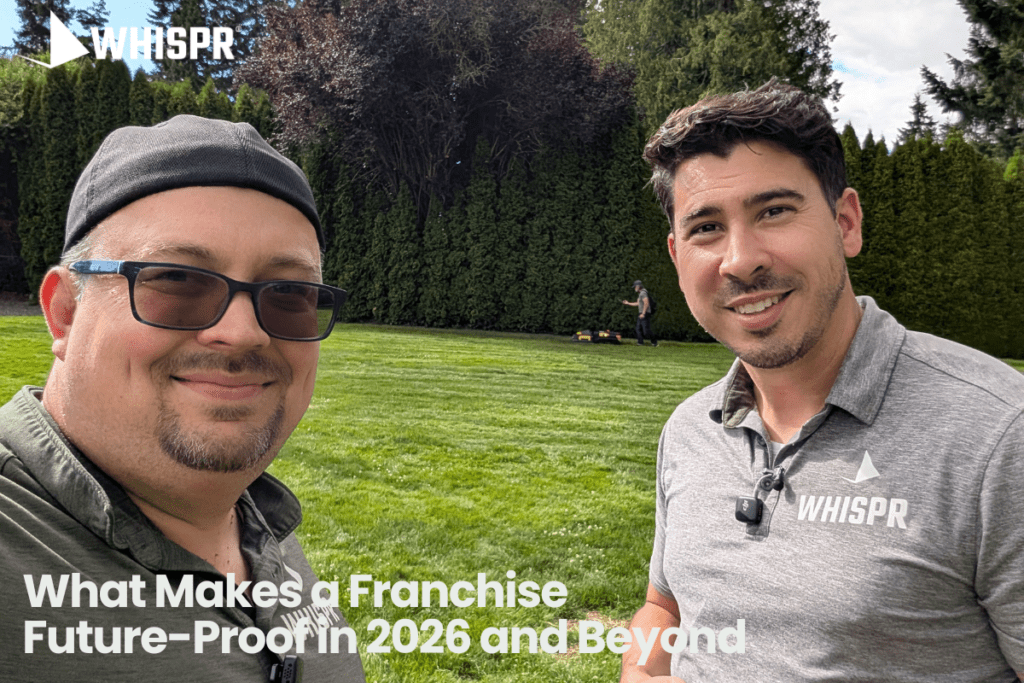
Future-Proof Franchise
What Makes a Franchise Future-Proof
If you’re considering franchise ownership today, you’re not just buying a business—you’re making a long-term bet on relevance.
The franchise models that worked 10 or even 5 years ago are being challenged by rapid shifts in technology, labor, consumer expectations, regulation, and environmental responsibility. As we move toward 2026 and beyond, the question every serious franchise buyer should ask is:
“Will this franchise still work when the world changes again?”
A future-proof franchise is not one that resists change—it’s one that is designed to evolve with it. Below, we break down the key traits that separate resilient, scalable franchises from those at risk of becoming obsolete—and why Whispr is positioned on the right side of that divide.
What Does “Future-Proof” Really Mean in Franchising?
A future-proof franchise is a business model built to withstand and adapt to:
- Technological disruption
- Labor shortages and rising wages
- Shifting consumer behavior
- Environmental regulation
- Market saturation and price competition
In simple terms, it means the franchise can stay profitable, relevant, and competitive even as external conditions change.
This is especially important for franchise owners, who are typically making:
- A multi-year financial commitment
- A career transition
- A local market investment
Let’s look at the core pillars that define a future-proof franchise in 2026 and beyond.
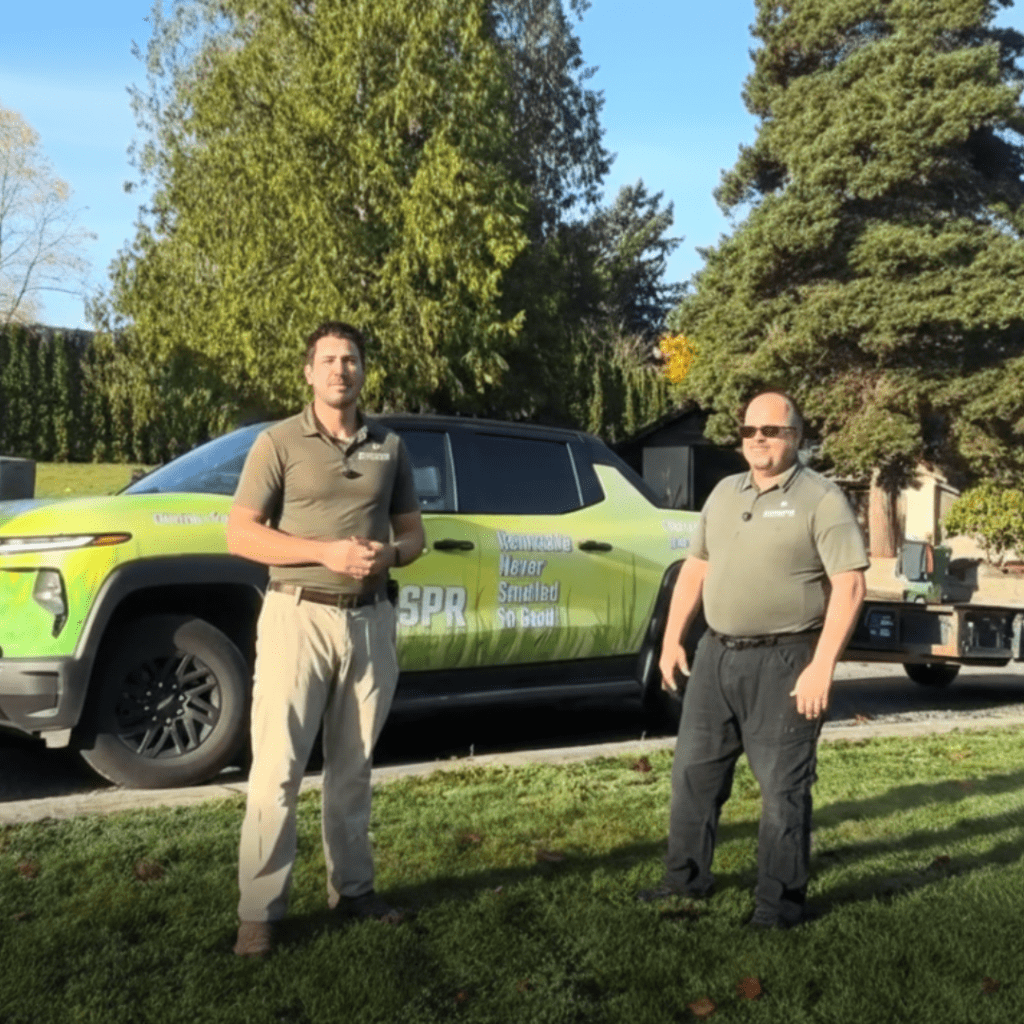
1. Technology That Enhances Humans (Not Replaces Them)
One of the biggest fears prospective franchise owners have today is AI and automation.
The reality?
Technology isn’t the threat—poorly designed systems are.
Future-proof franchises use technology to:
- Reduce inefficiency and burnout
- Eliminate repetitive, low-value tasks
- Improve consistency and customer experience
- Allow owners to focus on growth, leadership, and service
Why This Matters
Franchises that rely solely on manual labor, outdated systems, or “tribal knowledge” are increasingly vulnerable. Labor is more expensive, harder to find, and less predictable than ever.
Whispr was built with this reality in mind.
By integrating robotics, automation, and AI-supported systems, Whispr creates a model where:
- Technology handles repetitive, time-consuming work
- Humans remain central to service, oversight, and relationships
- Franchise owners gain leverage instead of burnout
This isn’t about replacing people—it’s about making people more effective.
2. A Business Model That Solves Labor Challenges
Labor is now one of the top risk factors in franchising.
Wage pressure, turnover, and seasonal staffing issues can cripple traditional service franchises. Many models still depend on:
- Large crews
- High turnover roles
- Manual processes that don’t scale
A future-proof franchise reduces dependency on fragile labor structures.
How Whispr Addresses This
Whispr’s model blends:
- Robotic lawn care
- Battery-electric equipment
- Smarter routing, monitoring, and scheduling
This results in:
- Fewer people needed to deliver consistent service
- New, higher-skill roles (like robotic technicians)
- More predictable operations
Franchise owners aren’t constantly “chasing staff”—they’re building systems.
3. Environmental Readiness (Not Greenwashing)
Sustainability is no longer a trend—it’s a regulatory and consumer reality.
Cities and municipalities are already:
- Restricting gas-powered equipment
- Enforcing noise ordinances
- Incentivizing zero-emission solutions
Consumers, especially homeowners and commercial property managers, are increasingly choosing vendors who align with their values.
A future-proof franchise doesn’t scramble to comply—it’s already ahead.
Whispr’s Advantage
Whispr was built on:
- Zero-emission lawn care
- Battery-electric fleets and tools
- Quiet, low-impact operations
This positions franchise owners to:
- Enter markets competitors can’t
- Win environmentally conscious customers
- Avoid costly, reactive transitions later
Being early is safer than being late.
4. Differentiation That Can’t Be Easily Copied
One of the biggest risks in franchising is commoditization.
If your franchise competes primarily on:
- Price
- Speed
- “We’re nicer” marketing
…you’re vulnerable.
Future-proof franchises operate in categories, not price wars.
Whispr’s Differentiation
Whispr isn’t just another lawn care franchise—it operates at the intersection of:
- Robotics
- Smart outdoor living
- Sustainability
- Premium, quiet service
This creates a competitive moat that’s difficult for:
- Independent operators
- Low-cost providers
- Traditional franchises
to replicate quickly or affordably.
Differentiation protects margins—and sanity.
5. Scalable Systems, Not Founder Dependency
Many franchises look strong on the surface but rely heavily on:
- A charismatic founder
- Informal processes
- “Figure it out as you go” operations
That’s not scalable—and it’s not safe for franchise owners.
A future-proof franchise has:
- Documented systems
- Ongoing innovation pipelines
- Centralized support and R&D
Why This Matters for Franchise Owners
You’re not just buying today’s business—you’re buying tomorrow’s upgrades.
Whispr operates as an ongoing R&D hub, continuously:
- Testing new technology
- Improving processes
- Adding services and revenue streams
Franchisees benefit from innovation without bearing the cost or risk alone.
6. Revenue Models Designed for Stability
Future-proof franchises don’t rely solely on one-off transactions.
They favor:
- Recurring revenue
- Long-term service relationships
- Predictable cash flow
Whispr’s model supports this through:
- Ongoing service contracts
- Technology-enabled maintenance
- Repeat, relationship-driven customers
This reduces seasonality risk and increases enterprise value for owners.
7. Alignment With Where the Market Is Going (Not Where It’s Been)
The most dangerous phrase in business is:
“This is how it’s always been done.”
Future-proof franchises are aligned with:
- Smart home adoption
- Automation normalization
- Environmental accountability
- Experience-driven purchasing
Whispr sits squarely at the intersection of these trends.
As outdoor spaces become smarter, quieter, and more automated, Whispr franchise owners are positioned ahead of demand, not chasing it.
So, Is Whispr a Future-Proof Franchise?
No franchise is risk-free.
But the franchises most likely to thrive in 2026 and beyond share clear characteristics:
- Technology-enabled, not tech-dependent
- Labor-resilient
- Environmentally aligned
- Operationally systemized
- Strategically differentiated
Whispr was designed with these realities at its core—not retrofitted after the fact.
For franchise buyers who want:
- A business that evolves
- A model that reduces friction
- A brand aligned with the future of home services
Whispr represents a fundamentally different approach to franchising.
Final Thought
The best time to buy into the future is before it becomes obvious.
A future-proof franchise isn’t about predicting every change—it’s about building a system that can adapt when change arrives.
That’s the difference between surviving the next decade and thriving in it.
Frequently Asked Questions
What is a future-proof franchise?
A future-proof franchise is a business model designed to adapt to long-term changes in technology, labor, consumer behavior, and regulation. Instead of relying on outdated processes or price competition, future-proof franchises use scalable systems, automation, and strong differentiation to remain profitable and relevant over time.
How do I know if a franchise will still be profitable in 10 years?
A franchise is more likely to remain profitable long-term if it reduces dependency on manual labor, uses technology to improve efficiency, offers recurring revenue opportunities, and aligns with long-term market trends such as sustainability and automation. Franchises built to evolve are safer than those built to stay the same.
Are technology-driven franchises a safer investment?
Technology-driven franchises can be safer investments when technology is used to support people, not replace them. Franchises that leverage automation, data, and smart systems tend to scale more efficiently, deliver more consistent customer experiences, and better withstand labor shortages and rising costs.
What industries are best for future franchise ownership?
Industries positioned for future franchise growth include home services, sustainability-focused businesses, technology-enabled services, and smart home or automation-related sectors. These industries benefit from recurring demand, regulatory tailwinds, and evolving consumer expectations.
Why is sustainability important when choosing a franchise?
Sustainability matters because environmental regulations, noise restrictions, and consumer preferences are increasingly influencing purchasing decisions. Franchises that already operate with low emissions, quiet equipment, and environmentally responsible practices are better positioned to avoid future compliance costs and attract long-term customers.